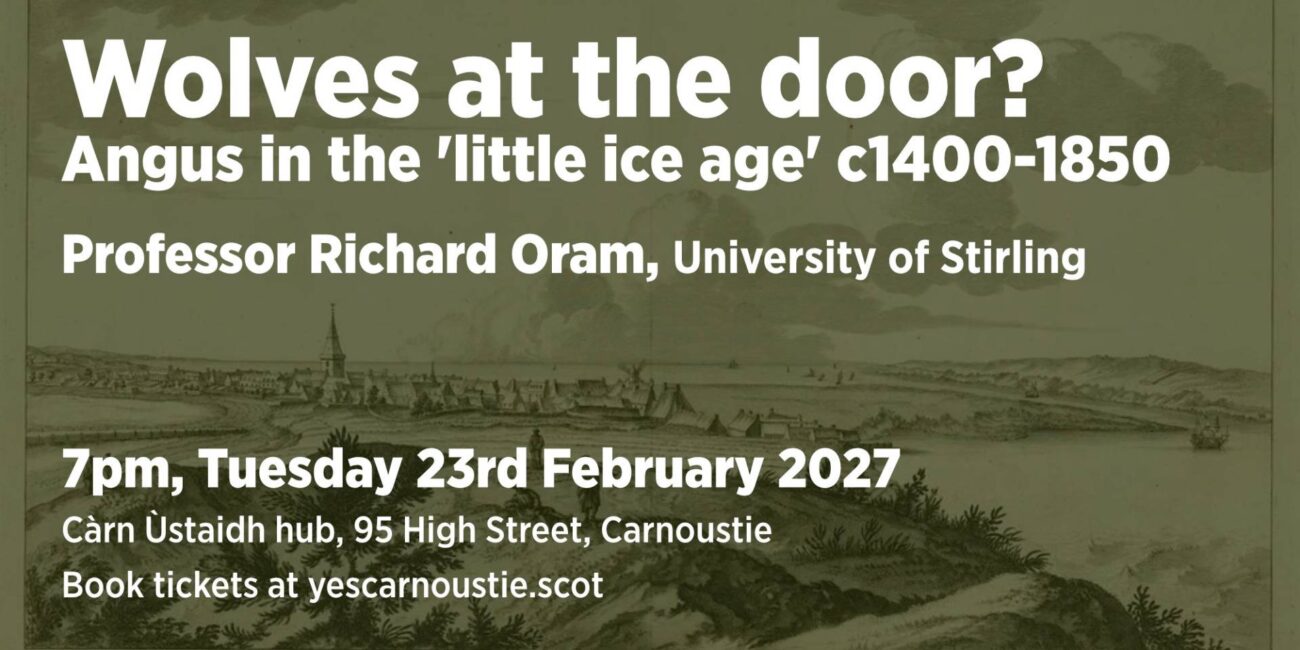
Wolves at the Door: Angus in the Little Ice Age
DateTue, 23 Feb 2027
Time18:30 – 21:00
VenueCàrn Ùstaidh Hub
Address95 High St, Carnoustie DD7 7EA, UK
While the 14th century has been labelled as the ‘worst century’ in which to be alive in human history, the 450 years of the so-called ‘little ice age’ (1400-1850) struck Scotland with a succession of crises that made the disasters of the 1300s fade in significance. In this talk, we will see how the people of Angus fared in an era of climate instability and dramatic weather extremes, where age-old predators like the wolf came down from the mountains, worsening the struggle to subsist in a turbulent age. We will explore their quest for reliable fuel supplies, consider how they sourced building materials, and examine how they looked to increase resilience in challenging times, igniting the spark of ‘improvement’ that transformed agriculture and, with it, reshaped the landscape into what we would recognise today in Strathmore and south-eastern Angus.
We shall see failures, like Dronner’s Dyk3 in the Montrose Basin, successes, like the draining of the Dean marshes, and consider the environmental costs of the profound transformation wrought in every part of the land from the high plateau of the Mounth to the saltmarshes and sands of Buddon Ness.
Richard Oram is professor-emeritus of Scottish Medieval and Environmental History at the University of Stirling. A graduate of St Andrews, he has a background in history and archaeology which provided the basis for his work in environmental history since his appointment at Stirling in 2002. He has researched and published extensively on Scottish history, with political biographies of King David I and King Alexander II and many research papers on lordship, the medieval church and religious practice, and on environmental history, especially on aspects of historic climate change, energy transitions, and disease.